



Archaeological discovery extends Cixi's history back 4,100 years
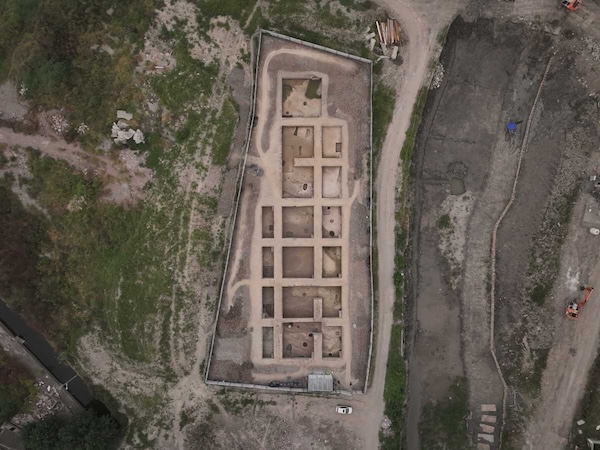
An aerial view of Zhouxi Ruins in Zhouxiang town, Cixi, a county-level city of Ningbo. [Photo/Yongpai App]
The Ningbo institute of cultural heritage announced on Dec 17 the discovery of the Zhouxi Ruins in Zhouxiang town, Cixi, revealing a cultural sequence that stretches back more than 4,100 years.
The excavation was carried out in 2025 to safeguard local heritage during a flood‑control project. Archaeologists uncovered a settlement with continuous layers spanning the Neolithic Guangfulin culture, Eastern Zhou Dynasty (770-256 BC), Southern Dynasty (420-589), Tang–Five Dynasties Five Dynasties Period (907-959), Song Dynasty (960-1279), and Ming and Qing dynasties (1368-1911). The site vividly illustrates the resilience and evolution of human communities along Hangzhou Bay's southern shore.
Artifacts highlight key stages of local civilization. Neolithic finds include sand‑tempered pottery and stone tools, typical of Guangfulin culture. Eastern Zhou relics feature primitive celadon, showing early advances in ceramic technology. Tang and Song layers yielded ware celadon bowls and jars of Yue kiln, confirming Cixi's role as a core production hub during China's golden age of porcelain. Later strata produced Ming and Qing blue‑and‑white porcelain decorated with floral, dragon, and taiji motifs, reflecting both artistry and cultural symbolism.
Nearly 150 items have been recovered, offering a detailed panorama of Cixi's cultural evolution. The Zhouxi Ruins not only extend Zhouxiang's historical timeline but also provide valuable material for studying settlement expansion, ecological adaptation, and artisanal progress.

 play
play